
Government exams14 October 20265 min read
What Normalisation Is, Explained With One Two-Shift Example
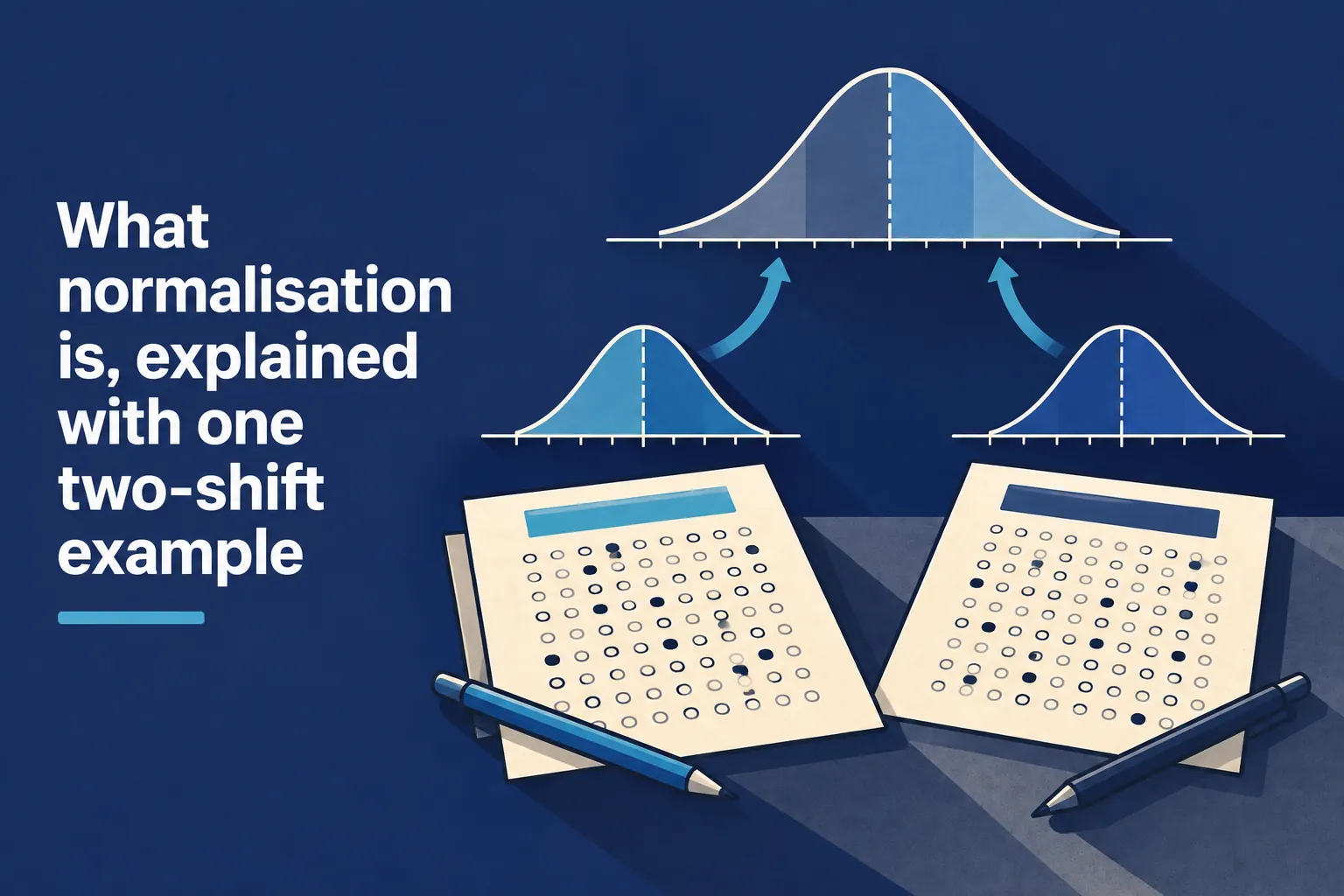
Normalisation adjusts scores so candidates from harder and easier shifts can be compared fairly. One worked example explains the whole idea in five minutes.
Key takeaways
- Normalisation exists because large exams cannot run in one shift, and different shifts get different papers.
- Without it, the easiest shift would win, which would be a lottery rather than a selection process.
- The principle is simple: compare each candidate against the people who sat the same paper, then put those comparisons on a common scale.
- A lower raw score in a harder shift can beat a higher raw score in an easier one. That is the system working, not failing.
- It applies to JEE Main, SSC, RRB, CUET and many state exams. NEET does not use it, because it runs in a single shift.
- Different bodies use different methods, but every one of them answers the same question.
- You cannot game it, and the only input you control is how many questions you get right.
The problem normalisation solves
An exam with twenty lakh candidates cannot be held in one room on one morning. It runs across many shifts spread over several days, and each shift gets a different question paper so that candidates sitting later cannot benefit from knowing the questions.
Different papers are never equally difficult. Two sets of questions built to the same syllabus and the same blueprint will still come out slightly harder or slightly easier, and over a hundred questions that difference adds up.
So a candidate in the Tuesday morning shift and a candidate in the Thursday afternoon shift did not sit the same exam. Ranking them on raw marks would reward whoever drew the gentler paper, and that is a lottery dressed as a merit list.
Even if $9 invested today doubled in five years...
$9 spent on mocks today could change what you’re earning in five years.
Pro for one exam · one year of access.
The idea, in one sentence
Judge each candidate against the people who sat the same paper, then place those judgements on a scale that works across all the papers.
That is the whole concept. Everything else is arithmetic.
A worked example
Two shifts, a thousand candidates in each. Shift A gets a straightforward paper. Shift B gets a hard one. The numbers below are invented to make the effect visible.
| Shift A, easier | Shift B, harder | What it tells you | |
|---|---|---|---|
| Average raw score | 110 out of 200 | 82 out of 200 | Shift B was harder for everyone |
| Highest raw score | 186 | 171 | Even the best found B harder |
| Candidates above 140 | 180 of 1,000 | 45 of 1,000 | The same mark is rarer in B |
Now take two candidates.
| Candidate | Shift | Raw score | Position within their own shift |
|---|---|---|---|
| Rohit | A, easier | 145 | Beat about 83 per cent of his shift |
| Sneha | B, harder | 138 | Beat about 96 per cent of her shift |
Rohit scored seven marks more than Sneha. Sneha performed far better. Out of a thousand people facing her paper, she finished ahead of roughly 960. Rohit, facing an easier paper, finished ahead of roughly 830.
Normalisation converts both onto a common scale, and Sneha comes out ahead despite the lower raw score. If the exam had ranked on raw marks, Rohit would have been selected and Sneha would not, purely because of which day they were assigned.
How different bodies do it
The principle is universal. The method varies, and the differences matter mainly when you are trying to interpret your own scorecard.
| Body | Broad approach | What appears on your result |
|---|---|---|
| NTA, for JEE Main and CUET | Converts raw scores into percentiles within each shift | A percentile, not marks |
| SSC | Adjusts raw scores using the statistical profile of each shift | A normalised mark, not your raw mark |
| Railway Recruitment Boards | Adjusts raw scores across shifts before the merit list | A normalised mark |
| IIMs, for CAT | Converts raw into a scaled score, then a percentile | A scaled score and a percentile |
NEET is the notable exception. It runs as one paper in one sitting, so there is nothing to normalise and raw marks out of 720 stand as they are.
Three things candidates get wrong
That a hard shift is bad luck. It is not. A hard paper is hard for everyone sitting it, and normalisation adjusts for that. The candidate who walks out of a brutal shift feeling finished is usually in a better position than they think.
That you can game it by choosing a shift. You cannot. Shifts are allotted, not chosen, and even if you could choose, the adjustment removes the advantage you would be chasing.
That a mismatch between your calculated marks and your scorecard is an error. It is normalisation doing exactly what it was designed to do. Your raw count from the answer key is the input, not the output.
What follows from all three is the same conclusion. The only variable you control is how many questions you answer correctly, and no amount of understanding the formula changes that. Understanding it is still worth five minutes, because it stops you misreading your own result.
Our mock tests run on the official pattern for each exam, so the score you practise against means what it will mean on the day: mock tests
Frequently asked questions
What is normalisation in competitive exams?
A process that adjusts scores from different exam shifts so candidates who sat different papers can be compared fairly. It compares you against the people who sat your paper, then puts those comparisons on a common scale.
Can a lower score beat a higher score after normalisation?
Yes, and it is supposed to. A lower raw score achieved in a harder shift can outrank a higher score from an easier shift, because the two candidates did not face the same paper.
Which exams use normalisation?
Most multi-shift exams, including JEE Main, CUET, SSC exams and railway recruitment exams. NEET does not, because it runs in a single shift.
Why is my scorecard different from the marks I calculated?
Because your raw count is the input to normalisation, not the result. The figure on your scorecard is the adjusted score, which can sit above or below your raw marks.
Can I choose an easier shift?
No. Shifts are allotted by the conducting body, and normalisation is designed specifically to remove any advantage from drawing an easier paper.
Disclaimer: Normalisation methods differ between conducting bodies and are revised from time to time. The example above is illustrative, using invented figures to demonstrate the principle rather than any exam's actual formula. Refer to the official information bulletin of your exam for its specific methodology.