
Defence21 October 20267 min read
AFCAT Full Form, and the Branches It Actually Recruits For
AFCAT stands for Air Force Common Admission Test. See the three branches, who is eligible for each, the unusual marking scheme and what the AFSB adds.
Key takeaways
- AFCAT stands for the Air Force Common Admission Test, conducted by the Indian Air Force twice a year.
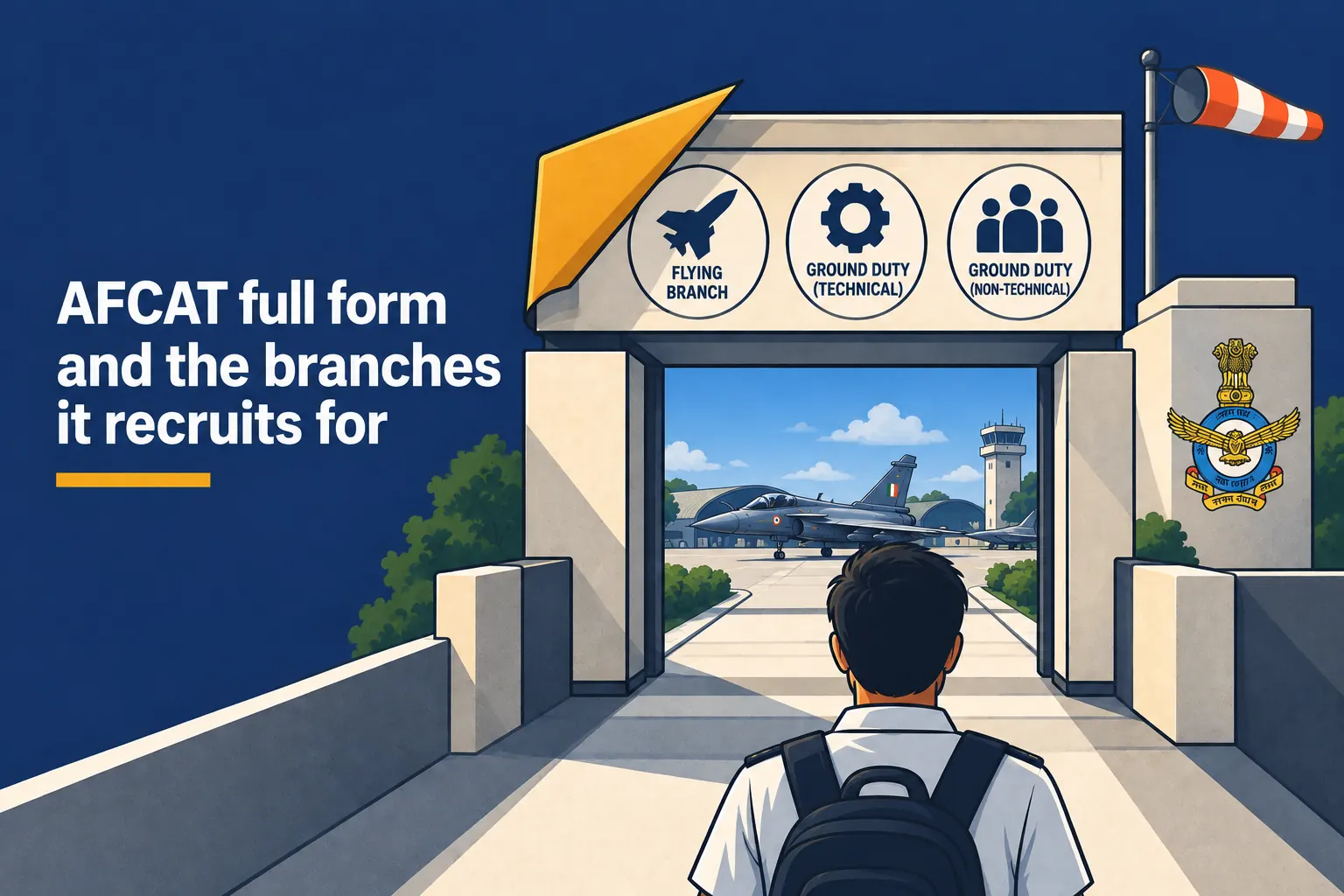
- It recruits for three branches: Flying, Ground Duty (Technical) and Ground Duty (Non-Technical).
- Open to men and women, which separates it from several other defence entries.
- The paper is 100 questions for 300 marks in two hours, with an unusual scheme: 3 marks for a correct answer and 1 mark deducted for a wrong one.
- Age is roughly 20 to 24 for Flying and 20 to 26 for Ground Duty.
- Clearing the paper gets you an AFSB interview, and most candidates are sent home on the first day of it.
- The Air Force has not run the Engineering Knowledge Test in every recent cycle, so check the notification rather than assuming.
What AFCAT stands for
Air Force Common Admission Test. The Indian Air Force conducts it twice a year, usually referred to as AFCAT 1 and AFCAT 2, to commission Group A gazetted officers.
The word worth pausing on is common. The Air Force once ran separate entrance tests for its flying, technical and ground duty entries. AFCAT replaced them with a single written paper, after which your branch is decided by what you applied for and what you are eligible for, not by which paper you sat.
Even if $9 invested today doubled in five years...
$9 spent on mocks today could change what you’re earning in five years.
AFCAT Pro · one year of access.
The three branches
| Branch | What the job is | Who it suits |
|---|---|---|
| Flying | Flying fighter, transport or helicopter aircraft | The smallest intake and the hardest entry, with the strictest medical standards |
| Ground Duty (Technical) | Engineering and maintenance of aircraft, electronics and weapon systems | Engineering graduates |
| Ground Duty (Non-Technical) | Administration, logistics, accounts, education, meteorology and weapon systems | Graduates from any discipline, subject to the conditions each stream sets |
Most candidates arrive wanting the Flying branch. It is worth being clear with yourself early that Flying has by far the fewest vacancies and the tightest medical criteria of the three, and that a medical standard is not something preparation can influence. The Ground Duty branches commission the same rank of officer into the same service, with far more positions available.
Non-technical does not mean general purpose
The Ground Duty (Non-Technical) label covers several distinct streams, and they do not share one eligibility rule. Administration and Logistics accept graduates broadly. Accounts, Education and Meteorology each carry their own subject conditions, and the Weapon Systems stream asks for Physics and Maths at Class 12 alongside the degree requirement.
Read the stream, not the heading. Candidates apply under the non-technical umbrella and then discover at the document stage that the specific stream needed a subject they do not have.
Who can apply
| Branch | Approximate age | Education |
|---|---|---|
| Flying | 20 to 24 | Graduation with Physics and Maths at 10+2, or an engineering degree. Minimum percentage conditions apply |
| Ground Duty (Technical) | 20 to 26 | Four year engineering degree, with Physics and Maths at 10+2 |
| Ground Duty (Non-Technical) | 20 to 26 | Graduation in a relevant discipline, with the percentage and subject conditions each stream sets |
Age is calculated as on a date stated in the notification, not as on the exam day, and holders of a valid commercial pilot licence have historically been allowed a relaxation on the Flying branch ceiling. Candidates must be unmarried at the time of application for most entries, and marrying during training is not permitted.
Final year students can usually apply on the condition that results are produced by a stated deadline. The percentage requirements are real gates rather than guidelines, and they trip up more applicants than the age limits do.
The paper, and a marking scheme you should not ignore
| Paper | Questions | Marks | Duration |
|---|---|---|---|
| AFCAT | 100 | 300 | 2 hours |
| Engineering Knowledge Test | 50 | 150 | 45 minutes |
The AFCAT paper covers General Awareness, Verbal Ability in English, Numerical Ability, and Reasoning and Military Aptitude. It is conducted online and in English only, with no regional language option.
The marking scheme is where AFCAT differs from almost every other exam you will have practised for. A correct answer earns 3 marks. A wrong answer costs 1 mark. No marks are deducted for leaving a question blank.
Work out what that ratio actually does, because the big numbers are misleading. A correct answer is worth three times what an error costs, and with four options that is exactly break even. Guess blindly and you are right once in four for 3 marks, wrong three times in four for 1 mark each, and you finish where you started. The scheme looks generous beside a one third penalty and behaves identically.
The penalty is one third of the marks for a correct answer, just as in CAT MCQs. Eliminate two of four options and a fifty-fifty attempt has a positive expected gain. Eliminate nothing and you are spending time for no expected return, which on a 100 question paper in two hours is the resource you can least afford.
The Engineering Knowledge Test applies to Ground Duty (Technical) candidates and is set by engineering discipline. The Air Force has not conducted it in every recent cycle, so treat it as conditional and check the notification you are applying under.
The AFSB is where the real filtering happens
Clearing the written paper gets you called to an Air Force Selection Board, and the AFSB runs in two stages across roughly five or six days.
| Stage | What happens | Outcome |
|---|---|---|
| Stage 1 | Officer Intelligence Rating test, picture perception and discussion, on day one | A large share of candidates are screened out and sent home the same day |
| Stage 2 | Psychological tests, group tasks and a personal interview over several days | Recommendation, followed by a medical |
Stage 1 removes a substantial proportion of candidates within hours of arriving, and it has no relationship to your written score. A candidate who topped the paper and a candidate who scraped the cutoff walk into the same room on day one with the same chance. Flying branch candidates additionally sit a pilot aptitude test, which can be attempted only once in a lifetime across all entries.
Training runs for roughly 74 weeks for the Flying and Technical branches and around 52 weeks for the Non-Technical Ground Duty branches, after which you are commissioned.
Our AFCAT mock tests use the +3 and -1 marking scheme, so you can practise your attempt strategy and review its effect on your score.
Frequently asked questions
What is the full form of AFCAT?
Air Force Common Admission Test. The Indian Air Force conducts it twice a year to commission officers into the Flying and Ground Duty branches.
Can women apply for AFCAT?
Yes. AFCAT is open to both men and women across its branches, subject to the eligibility conditions and vacancies announced in each notification.
Is AFCAT only for engineers?
No. Only the Ground Duty (Technical) branch requires an engineering degree. The Flying branch accepts graduates with Physics and Maths at Class 12, and the Non-Technical streams accept graduates from a range of disciplines.
What is the negative marking in AFCAT?
One mark is deducted for a wrong answer, against three marks for a correct one. Unanswered questions carry no penalty. The wrong-answer penalty is one third of the marks awarded for a correct answer.
Is the Engineering Knowledge Test compulsory?
It applies only to Ground Duty (Technical) candidates, and the Air Force has not held it in every recent cycle. Confirm against the notification you are applying under.
Disclaimer: Branch eligibility, age windows, percentage requirements and the conduct of the Engineering Knowledge Test are set by the Indian Air Force in each notification and have changed between cycles. The details above are given for general guidance. Always confirm against the current notification on afcat.cdac.in or the official Indian Air Force careers site before applying.