
Rankings11 October 20265 min read
The Toughest Exams in India, Ranked by Selection Ratio Rather Than Opinion
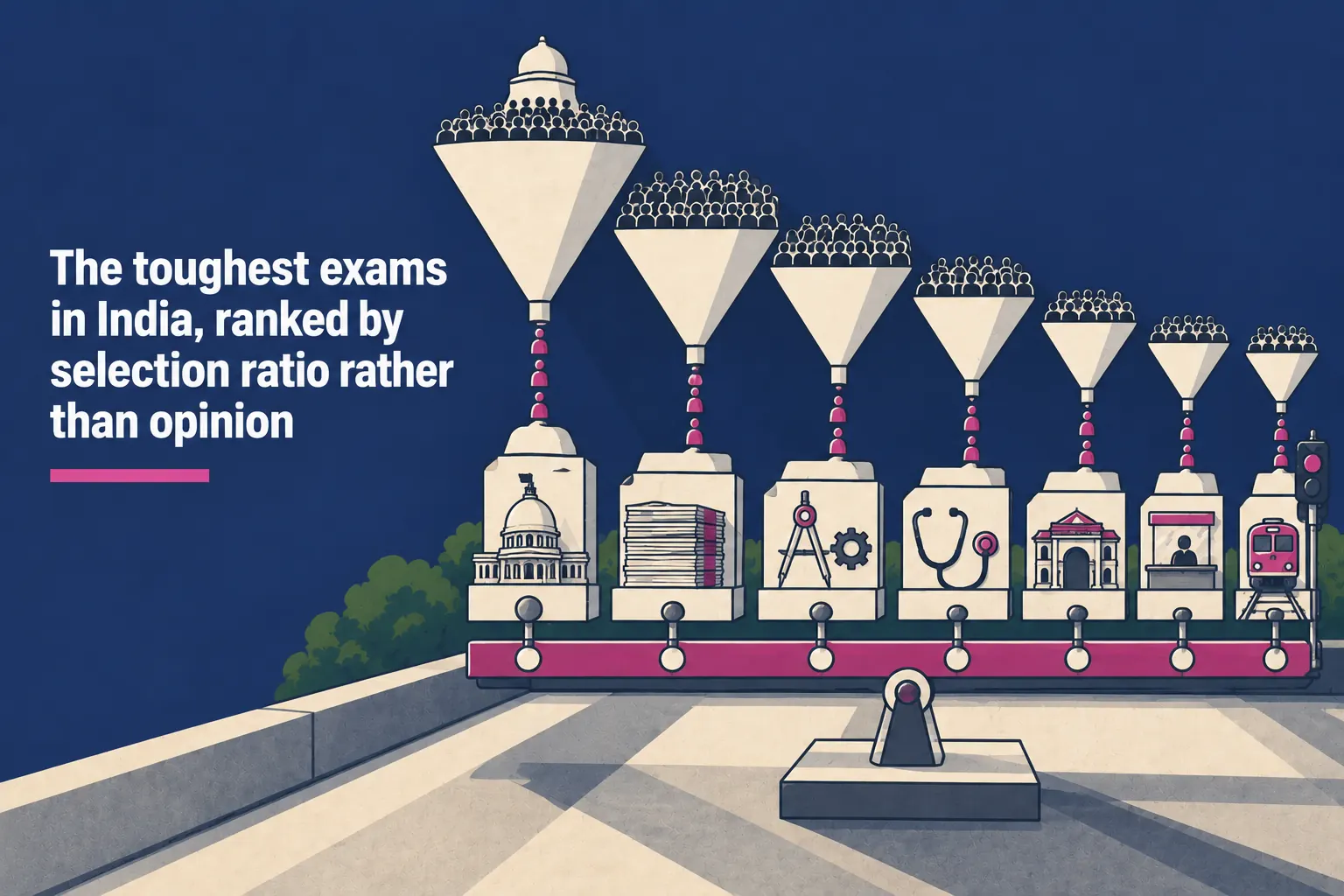
Most toughest exam lists are opinion in a numbered format. This one uses selection ratio, states the denominator for every figure, and shows how much that choice changes the ranking.
Key takeaways
- Most toughest exam rankings are opinion dressed as a list. Selection ratio at least has a number behind it.
- UPSC CSE is the hardest by a distance, at roughly 0.1 to 0.2 per cent of applicants.
- The denominator decides the ranking. JEE Advanced is around 10 per cent of those who appear and under 2 per cent of JEE Main registrants.
- NEET looks very different depending on whether you count qualifying, any MBBS seat, or a government MBBS seat.
- Around 5 per cent of NEET candidates get an MBBS seat and roughly half of those get a government one.
- CAT sits near 2 per cent for an IIM seat, and far lower for the oldest IIMs.
- A low ratio measures competition, not the difficulty of the paper.
Why most of these lists are worthless
Search for the toughest exams in India and you get a numbered list with no method behind it. The ordering is intuition, the justification is adjectives, and the same exams appear in different positions on different sites with no explanation.
Selection ratio is not a perfect measure and it is at least a measure. It asks one question: of the people who went in, how many came out with the thing they wanted. The figures below state the denominator every time, because that is where the manipulation usually happens.
Even if $9 invested today doubled in five years...
$9 spent on mocks today could change what you’re earning in five years.
Pro for one exam · one year of access.
The ranking
| Exam | Roughly how many | Outcome | Selection ratio |
|---|---|---|---|
| UPSC CSE | Around 5.5 lakh appear | Around 1,000 recommended | Around 0.2 per cent |
| JEE Advanced | Around 1.8 lakh appear | Around 17,000 IIT seats | Around 10 per cent |
| JEE Advanced | Around 13 lakh register for Main | Around 17,000 IIT seats | Under 2 per cent |
| CAT | Around 2.6 lakh appear | Around 5,000 to 6,000 IIM seats | Around 2 per cent |
| NEET UG | Around 22 lakh appear | Around 1.2 lakh MBBS seats | Around 5 per cent |
| NEET UG | Around 22 lakh appear | Around 55,000 government MBBS seats | Around 2.5 per cent |
UPSC sits alone at the top and nothing else is close. Roughly one candidate in five hundred who sits the Preliminary Examination is eventually recommended, and roughly one in a thousand of those who register.
Notice the two JEE Advanced rows
Both are true and they describe the same exam. Measured against the candidates who actually sit Advanced, the ratio is around ten per cent, which sounds manageable. Measured against everyone who registered for JEE Main with an IIT in mind, it falls under two per cent.
The second figure is the honest one for a candidate deciding whether to aim at an IIT, because they are at the start of the funnel rather than at the end of it. The first figure describes a group that has already been filtered twice.
The same trick appears in NEET coverage. Over half of NEET candidates qualify, which sounds encouraging and means only that they cleared the percentile threshold. Around five per cent get an MBBS seat anywhere, and around half of those get a government one.
What a low ratio does and does not tell you
| Selection ratio measures | It does not measure |
|---|---|
| How many people want the outcome against how many can have it | How hard the questions are |
| The scale of the competition | The depth of the syllabus |
| Your statistical chance as an uninformed outsider | Your chance given your actual preparation |
UPSC has a lower ratio than JEE Advanced and an easier paper, question for question. The UPSC Preliminary Examination is not conceptually harder than a JEE Advanced physics problem. What makes it brutal is the breadth, the duration of the process and the number of people chasing a thousand positions.
A ratio is a crowd measurement, not a question measurement, and conflating the two is how these lists mislead.
And it is not your probability
A 0.2 per cent selection ratio is not your chance of clearing UPSC. The denominator includes a very large number of people who registered casually, prepared for a few months, or sat one paper to see what it was like.
A prepared candidate on a second serious attempt faces a completely different set of odds from the headline figure, and no published ratio can tell you what they are. The ratio describes the crowd. Your preparation describes you.
Our mock tests show where you sit against the band for each exam, which is more useful than any national ratio: mock tests
Frequently asked questions
Which is the toughest exam in India?
By selection ratio, UPSC CSE, at roughly 0.2 per cent of candidates who appear and lower still as a share of those who register. Nothing else is close on that measure.
Why do different sites give different numbers for the same exam?
Usually because they use different denominators. Counting those who appeared, those who registered or those who qualified produces very different ratios for the same exam.
Does a low selection ratio mean the paper is hard?
No. It measures competition rather than question difficulty. UPSC has a lower ratio than JEE Advanced and a conceptually easier paper.
Is the selection ratio my chance of clearing?
No. The denominator includes many candidates who barely prepared, so a serious candidate faces different odds from the published figure.
How many NEET candidates get an MBBS seat?
Around five per cent of those who appear get a seat somewhere, and roughly half of those get a government seat. Far more than half qualify, which only means they cleared the percentile threshold.
Disclaimer: Figures are approximate, drawn from recent cycles and reported data, and change every year with applicant numbers, vacancies and seat intake. They are given for general illustration of relative competition rather than as precise statistics. Refer to official results and seat matrices for exact numbers.