
Strategy11 October 20264 min read
How Many Mocks Before the Exam, and When to Start
The honest answer is a schedule rather than a number. Here is when to start, how to space them, and why the analysis matters more than the count.
Key takeaways
- The number matters far less than the spacing and the analysis.
- Start earlier than feels comfortable, before the syllabus is finished.
- A mock taken when you are unprepared is a diagnostic, not a judgement.
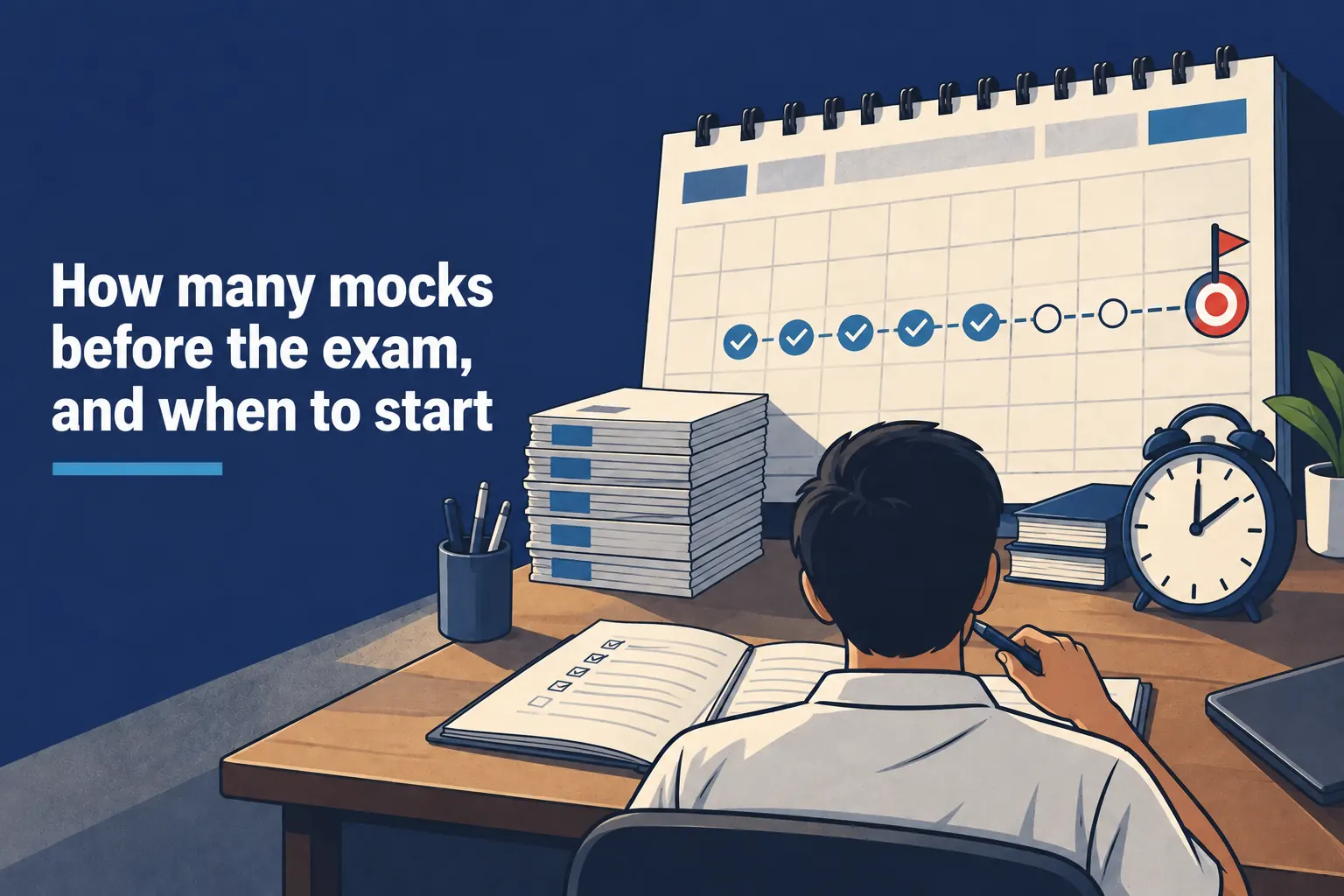
- A rough shape: one a fortnight early on, one a week in the middle, two a week in the final month.
- Every mock needs analysis time roughly equal to the paper itself, or it teaches you nothing.
- Taking mocks without analysing them is the single most common waste in competitive exam preparation.
- Stop taking new full mocks two or three days before the exam, and revise instead.
- For exams with two sessions, treat the first session as the most valuable mock available.
Why the number is the wrong question
Candidates ask how many mocks they should take, and the answers circulating range from fifteen to sixty. Both are defensible and neither is useful, because the count is not what produces the improvement.
Thirty mocks taken and never analysed are worth less than ten taken and studied properly. The paper tells you your score. The analysis tells you why, and only the second one changes anything.
Even if $9 invested today doubled in five years...
$9 spent on mocks today could change what you’re earning in five years.
Pro for one exam · one year of access.
When to start
Earlier than you want to. The most common error in mock strategy is waiting until the syllabus is complete, which usually means starting in the final six weeks.
| When you start | What you get | What you lose |
|---|---|---|
| Early, before the syllabus is done | A map of your weaknesses while there is time to fix them | A comfortable score |
| Late, after the syllabus is done | A comfortable score, sometimes | The time to act on what you learn |
A mock taken at thirty per cent syllabus completion is not a judgement on you. It is a diagnostic showing which sections are weak, how you handle the clock and whether your attempt strategy works. All of those are learnable, and all of them take months.
Candidates avoid early mocks because the score is discouraging, which is the reverse of how it should work. The score at that stage is meaningless and the information is valuable.
A workable schedule
| Phase | Frequency | What you are working on |
|---|---|---|
| Early, syllabus in progress | One a fortnight | Interface, pacing, identifying weak sections |
| Middle, syllabus mostly done | One a week | Attempt strategy, sectional balance, accuracy |
| Final month | Two a week | Consistency under pressure, fine tuning the plan |
| Final three days | None | Revision and error log review only |
That last row matters. A bad mock two days before the exam damages confidence and teaches you nothing you can act on. Stop taking new full papers and spend the time on your error log and your formula revision instead.
Take mocks at the time of day your exam will be held. A candidate who has always practised at ten at night and sits a two o'clock paper is testing a version of themselves they have never trained.
The analysis rule
Budget analysis time roughly equal to the length of the paper. A three hour mock needs around three hours of review, and candidates give it twenty minutes.
This is the real constraint on how many mocks you can take. If you cannot analyse two papers a week properly, you should not be taking two papers a week. The schedule above assumes the analysis happens, and without it the whole structure collapses into score watching.
The free mock nobody uses
For exams with two sessions, the first session is the most realistic mock available to you, and it is free.
In JEE Main, your better percentile across sessions counts. A candidate who sits the January session has had a full dress rehearsal in a real centre under real conditions, at no cost to their final result. Candidates skip it out of nerves and then sit their only attempt having never experienced the real thing.
No mock test reproduces the centre, the queue, the frisking or the nerves. Where the structure gives you a free attempt at that, take it.
Our mock tests run the full test window on the official pattern with analysis after every paper: mock tests
Frequently asked questions
How many mock tests should I take?
There is no fixed number. The spacing and the analysis matter more. A workable shape is one a fortnight early on, one a week in the middle and two a week in the final month.
When should I start taking mocks?
Before the syllabus is complete. Early mocks are diagnostics that show you what to fix while there is still time to fix it.
How long should I spend analysing a mock?
Roughly as long as the paper itself. If you cannot give a three hour mock three hours of review, you are taking too many.
Should I take a mock the day before the exam?
No. Stop taking new full papers two or three days out. A bad result at that point damages confidence and offers nothing you can act on.
Is the first session of a two session exam worth sitting?
Yes. Your better result counts, so it is a free full dress rehearsal in a real centre, which no mock test can reproduce.
Disclaimer: This article offers general preparation guidance. Individual circumstances, syllabus completion and exam patterns differ, and no schedule suits everyone. Adapt the structure above to your own situation and exam timetable.